

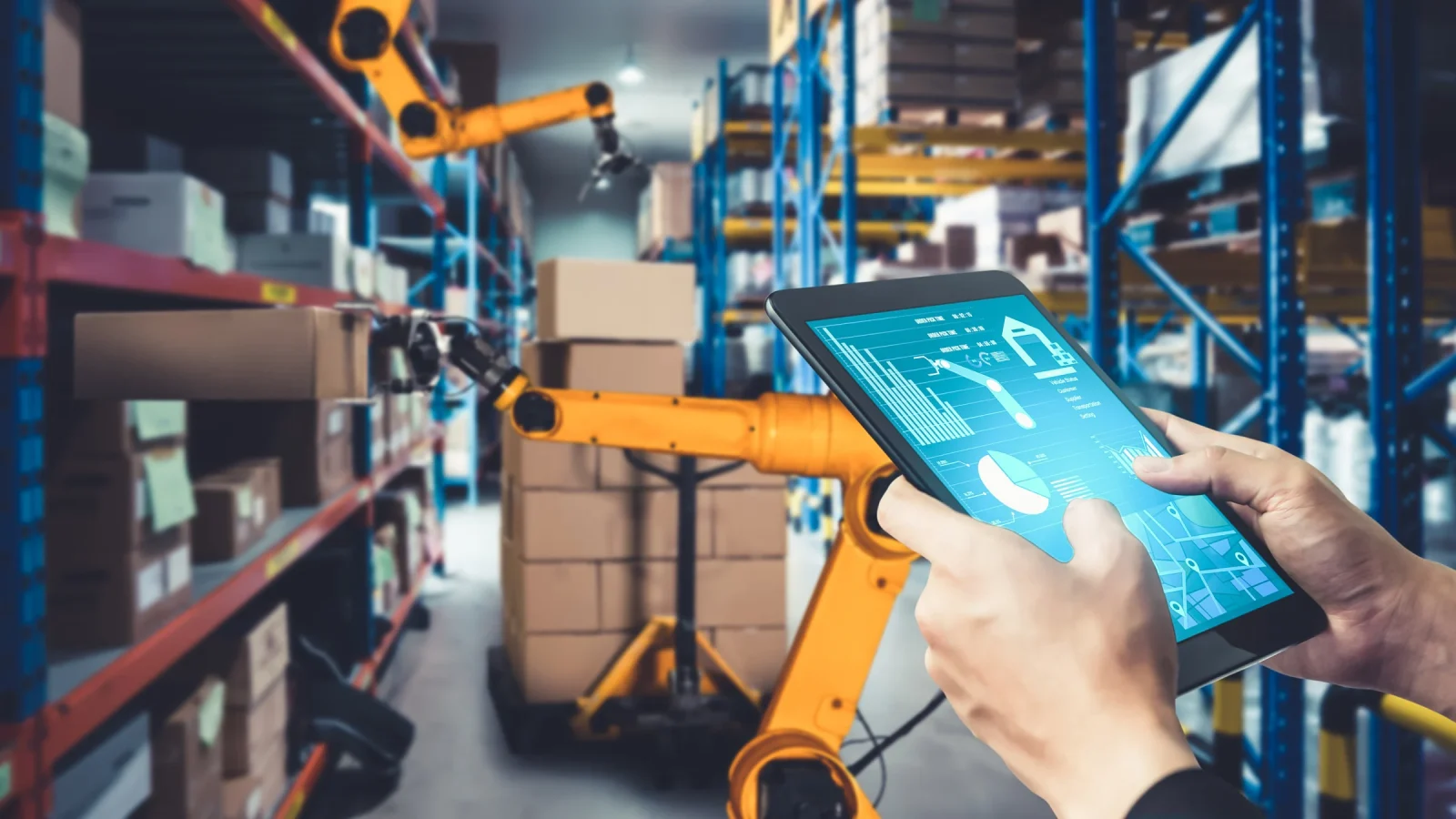
Today customers consider same-day delivery as a standard service, and no longer a premium one. They anticipate their purchases to be delivered so quickly, that it was only possible for a few enterprises to achieve this five years ago. The distribution centers that enabled this have completely transformed.
From Hours to Minutes: Compressing the Click-to-Ship Window
Traditional pick-and-pack operations involved deliberately slow manual work. A human employee would get a pick list, wander the warehouse to find the product, take it to a packing station, and hand it over for shipping. This process was intentionally time-consuming. But, for a warehouse fulfilling thousands of orders, each containing dozens of items, every day, those minutes added up.
Automated sorting systems, coupled with high-speed conveyors, have eliminated those minutes. When an order comes through, the system already knows where the SKU is stored. A robotic arm retrieves the item, a conveyor whisks it to packing, and computer-vision scanners verify the correct product before the package is sealed. What used to require three-quarters of an hour now can be completed in 300 seconds.
Less time to pick, pack, and ship has a ripple effect on the supply chain. More packages leave the warehouse earlier in the day, meaning more shipments meet the last-mile delivery window, meaning more customers receive their orders on time. The positive feedback loop spins up.
Fixed Versus Flexible: Why AMRs Changed the Warehouse Model
Traditionally, warehouse automation was a fixed installation. Conveyors, sorters, fixed racking, all of it was expensive to install and almost impossible to reconfigure. A business needing to manage a seasonal surge had to adapt its processes to a layout designed for average volume.
Autonomous Mobile Robots changed all that. AMRs self-navigate the warehouse floor, transporting inventory between zones without the need for fixed tracks or hardwired paths. And they react to the ebb and flow of your operation. Need more robots in the system during peak periods? Easy. Want to scale back when volume drops? No problem. It’s the difference between a static warehouse and a dynamic one.
This dynamic capability is critically important when it comes to supply chain disruption. When demand spikes unexpectedly, whether due to a viral product or a constrained supply, an AMR operated warehouse can respond in hours rather than weeks. Voila, no out of stocks. No surpluses. And no missed sales.
Doing More With the Same Square Footage
Industrial real estate comes at a premium, and it’s only becoming more expensive. While that’s not the fault of robots, it is one of their most practical benefits. Because one of the differences between old-style distribution centers and modern automated ones is that these days, you store vertically, rather than horizontally. In other words, you use the full cube of your building, rather than just its floor space. AS/RS technology stores inventory in locations that simply aren’t accessible to human pickers. The average automated facility can store four times the inventory in the same square footage compared to a conventional racking system. For a company trying to manage the relentless spread of SKU proliferation across hundreds of product variants, that density difference is the margin between viable and unviable.
Automation as Access, Not Just Advantage
This is where the conversation often gets stuck. When people discuss warehouse automation, they are usually referring to Amazon or a global retailer that has the funding to construct a warehouse. The assumption is that smaller companies can’t compete in that arena.
That’s changed. Today, mid-sized e-commerce brands can tap into automated warehousing. A third party logistics provider has already made the investment in building and running the warehouse, and a brand simply pays for the capacity it uses. The capital cost has shifted: Instead of spending capital on a robotic warehouse, a brand spends to purchase the needed capacity of an existing one.
Access, as we see it, is what levels the warehouse playing field. A company doing 500 orders a day can ship as fast and accurately as one doing 50,000 if the two players are on the same type of automated home field.
The Workforce Shift That Doesn’t Get Talked About Honestly
The whole idea of robots replacing humans is blown out of proportion and, at the same time, undermined. Automated systems do require fewer people to conduct repetitive picking. This is true.
But what those jobs are replaced by is cobot orchestration, workers who manage and oversee robotic fleets, deal with exception items that can’t be automated, manage returns, and make real-world judgment calls the robotic arm in the aisle can’t.
The job changes. The job doesn’t go away.
Predictive analytics further muddies the math. Automated systems work best when they can predict what’s going to happen next, including human operators needing that roll of poly or stretch film. And they are certainly good enough that a whole swath of high-demand inventory moves itself to the front of the picking zone before the order is placed because the system knows the order is coming.
These human operators aren’t working harder against the machine’s intransigence and wreaking havoc with inventory position. They are working smarter with the robot to fulfill orders seamlessly. This drive to higher order accuracy also plays into the equation, as returns are reduced, customer service calls drop, and less waste is attributed to the supply chain.
The warehouses that are building today at the front edge of this wave aren’t just faster. They are radically more transparent and have the ability to show clients what they are doing in real time. They are more adaptable and able to reconfigure themselves almost in real time to different processes and even radically different inventory. And in terms of cost per unit shipped, they are cheaper than legacy operations running on manual labor alone. For a business that is competing on global timelines, this is not an advantage. This is the floor.