

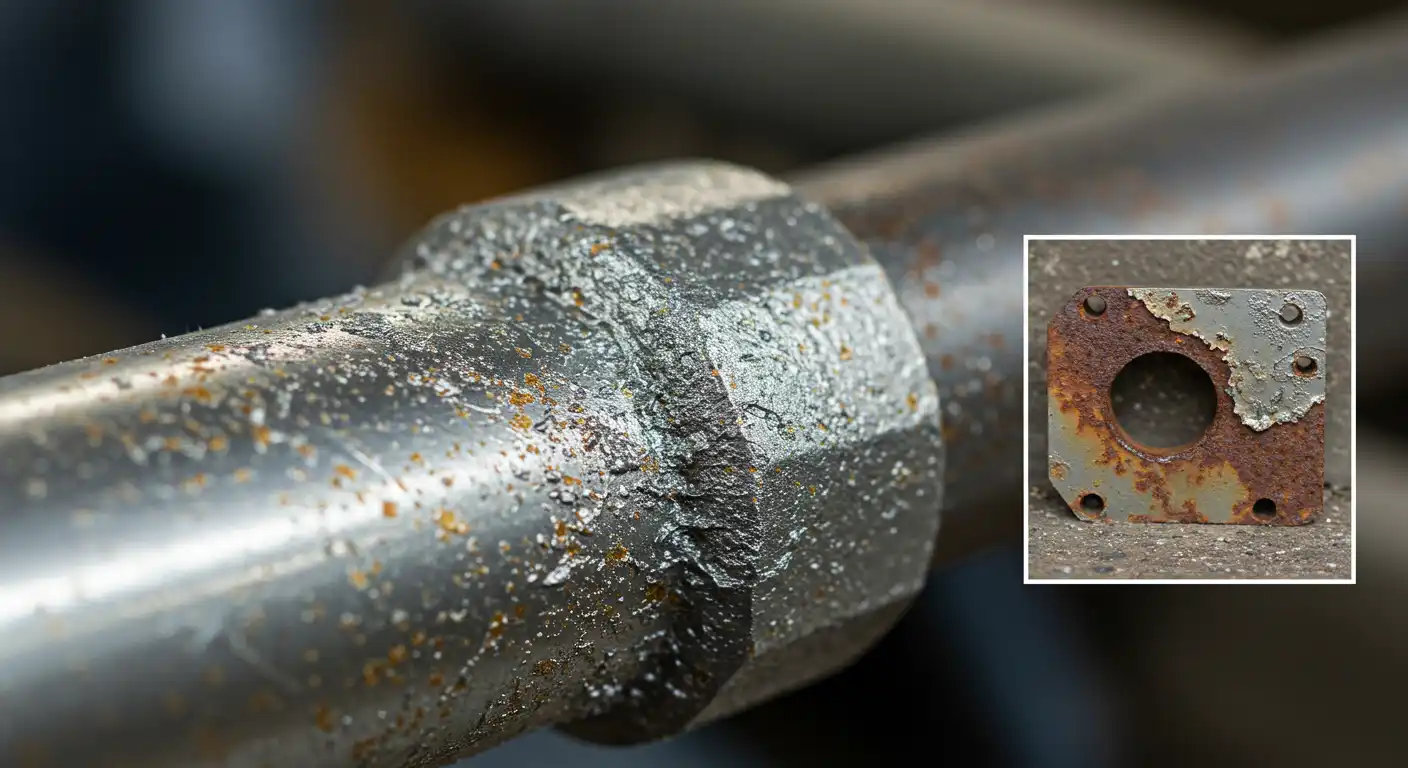
Most metal failures don’t start with a crack or fracture. They start with a layer of contamination that no one bothered to remove. Salt ions, carbon deposits, microbial sludge – these invisible threats work their way into surface porosity and sit there, steadily attacking the metal beneath while everything looks fine on the outside. By the time visible damage appears, the degradation has already been underway for months.
The Problem With “Invisible” Contamination
Surface rust is easy to spot and easy to take seriously. Chloride contamination is neither. Salt deposits left behind in coastal or industrial environments are one of the leading drivers of rapid metal decay, and they don’t always show up as obvious discolouration. Instead, they trigger localized pitting that works beneath the surface while the component looks serviceable.
The same applies to microscopic carbon deposits and airborne particulates that settle into the porous texture of metal surfaces. Once trapped against the substrate, these particles hold moisture in direct contact with the metal for extended periods. That moisture becomes an electrolyte, and electrolytic corrosion accelerates from there – particularly in humid environments where the surface never fully dries between cycles.
Microbial induced corrosion adds another layer of complexity. Bacteria living in stagnant fluids or compacted grime actively produce acids that attack metal surfaces, and this process is almost impossible to detect without close inspection. A component can be mechanically sound and visually unremarkable while MIC silently degrades it from contact surfaces inward.
Why Your Choice Of Cleaner Matters More Than Most People Realize
Household cleaners and solvents are produced with generic, “works on everything” intentions. The problem is, metal isn’t everything. Off-the-shelf cleaners and degreasers are often far too acidic or too alkaline for use in direct metal-surface contact. When it comes to sensitive or tension-bearing metals, keeping the pH steady is important.
When it’s too acidic, you risk stripping away the passive oxide layer that makes stainless steel stainless. That allows fresh metals to react with whatever is around causing instability and faster aging. Or alkaline products can generate hydrogen through the cleaning process actually increasing the corrosiveness of the disasters they were bought to protect against. High-tensile metal steels are especially prone – even in their tempered state – to corrosion and embrittlement damage from acid or overly alkaline cleaners used excessively.
Professional-grade Anti Corrosion Cleaning products are engineered with a balanced pH in particular. Targeting only contaminants and not molecularly through the layers of your metal. That makes a difference for a number of operations, including proper bonding and longevity of sealer and barrier coat applications.
Degreasers are an especially powerful example. If you have blooming oils trapping corrosive particulates against the metallic surface, over time, you need an industrial degreaser that actually solubilizes them. Regular degreasers just redistribute the soot. For a lifetime optimal finished job always use degreasers, lubricants and sealers designed specifically for the surface.
The Clean-Dry-Protect Sequence And Why Order Matters
The most prevalent metal maintenance mistake isn’t forgoing protection – it’s applying protection over a contaminated surface. Skewing dirt, moisture, or salt residue beneath a lubricant or sealant doesn’t negate the issue. It does, however, isolate it. You’ve just formed an anaerobic zone in which corrosion continues but is shielded from air, or light, and you won’t detect the damage until the coating fails or the part is next disassembled.
The correct order of events is quite simple: clean first, ensure the surface is dry, then protect. In this instance, the cleaning step has to be about total surface decontamination, not a cursory wipe. Substrate prep – removing all contaminants before anything protective comes into contact with the metal – decides whether that product becomes part of the solution, or the problem.
Crevice Corrosion And The Limits Of Standard Cleaning
Threaded fasteners, flanged joints, overlapping panels – anywhere two surfaces meet creates a geometry that standard cleaning can’t reach. Crevice corrosion develops in exactly these spaces because moisture and contaminants become trapped in areas with limited oxygen flow, creating differential aeration that drives localized decay.
This is where cleaning methodology matters as much as the product. Aerosol penetrants and ultrasonic cleaning methods can reach into crevices that cloth or brush application physically can’t access. For threaded components especially, running a contaminated fastener dry through reassembly is one of the fastest ways to initiate galvanic corrosion at the point of contact between dissimilar metals.
Heat Dissipation As A Maintenance Argument
Clean parts operate more efficiently and break down less often. Dust, dirt, oil, grease, or corrosion can greatly reduce the operational efficiency of mechanical parts and systems. Cleaning should not be overlooked as a simple step in maintaining equipment health; instead, it should be recognized as a critical component of any preventative maintenance program.
A regular cleaning schedule ensures parts are always inspected for wear and damage and are properly maintained. It prolongs their operational life which improves the performance and profitability of the equipment they make up.
The global cost of corrosion sits at an estimated US$2.5 trillion annually (NACE International/AMPP), and a significant portion of that figure is attributable to maintenance practices that could be changed without major capital investment.
Cleaning isn’t the least important step in metal protection. It’s the one that determines whether every step after it works.