

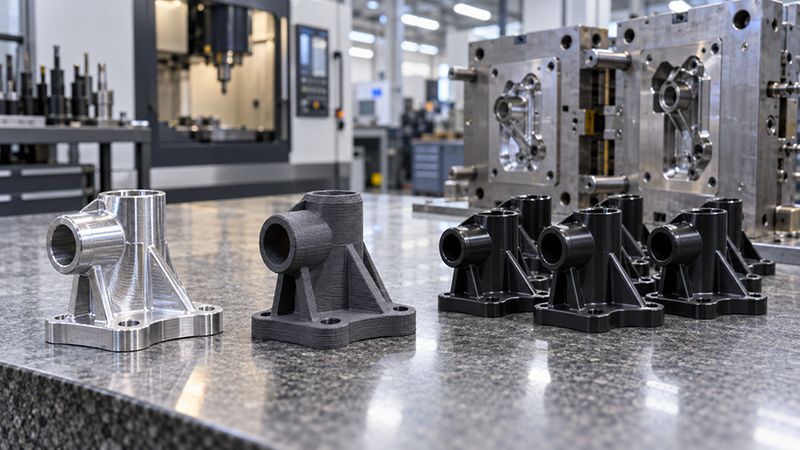
Deciding whether to prototype or go straight into production is one of the fastest ways to either de-risk a project or accidentally multiply cost and lead time. In metal fabrication, the right call depends less on how “simple” the part looks and more on what is truly unknown: fit, function, loads, tolerances, finishing, assembly sequence, and how consistently the part must be repeated. The goal is not to prototype by default. The goal is to spend money once, not twice, and avoid discovering avoidable problems after you have committed to volume.
Below is a practical, shop-floor-informed framework you can use to choose the best path.
Start with the real question: What is the cost of being wrong?
A prototype is not “extra.” It is insurance against the specific ways fabricated parts fail in the real world:
- The assembly does not fit because tolerance stack-up was underestimated.
- Weld sequence causes distortion, and the final geometry drifts.
- Holes that are “in the right place” on the drawing do not align in the build.
- A finish adds thickness and suddenly bolts, pins, or mating parts bind.
- A bracket that looks rigid on paper flexes under load, causing fatigue.
- Handling and shipping mar the finish or bend a feature that was marginal.
If any one of those outcomes would cause a line-down event, scrap expensive material, or create a safety risk, a prototype starts to look like the cheapest decision.
On the other hand, if being wrong means you adjust a non-critical bracket location and move on, production-first can be the smarter play.
What counts as a prototype in fabrication?
People hear “prototype” and imagine a fully finished, customer-ready part. In fabricated assemblies, prototypes can be staged and intentionally incomplete:
Proof-of-geometry prototype Confirms that cut, bend, and weld geometry works. Often unfinished, sometimes even built from cheaper material when acceptable.
Fit-up prototype Focuses on mating features: holes, slots, tabs, locating edges, and stack-up. You are proving assembly, not cosmetics.
Functional prototype Proves performance under load, vibration, temperature, or duty cycle. This may require the real material and welding method.
Process prototype (pilot build) Confirms repeatability, cycle time, fixtures, and inspection plan. For many manufacturers, this is the most valuable “prototype.”
The key is choosing the lightest prototype that answers the biggest risk.
When prototyping is strongly recommended
1. New design, new geometry, or new assembly sequence
If the design has not been built before, assume something will be learned the first time through. Fabricated parts behave differently than machined blocks. Heat input, weld access, clamp points, and sequence all matter.
Prototype when:
- There are multiple welded joints with tight positional tolerances.
- The assembly has long spans, thin sections, or large flat panels that are prone to warp.
- You have limited access for welding or inspection once assembled.
2. Tight tolerances that must survive welding and finishing
A common trap is specifying a tolerance that is achievable on a flat blank, but difficult after bending, welding, or coating.
Prototype when:
- Hole-to-hole position is critical across multiple fabricated members.
- Flatness or squareness is important after welding.
- Threaded features or sliding fits are present and a finish will be applied.
A prototype helps answer: “Do we need a fixture, a weld sequence change, or a redesign to hit this consistently?”
3. Interfaces to existing equipment or legacy parts
The risk is not the fabricated part. The risk is the unknown reality of the mating system. “As-built” rarely matches “as-documented,” especially with older equipment.
Prototype when:
- Your part mates to field-installed anchors, frames, conveyors, guards, or enclosures.
- You cannot fully control or measure the mating geometry ahead of time.
- Installation must happen in a narrow downtime window.
Even a basic fit-check prototype can prevent a painful installation surprise.
4. Material change or mixed-material assemblies
Switching from mild steel to stainless or aluminum is not just a line item. It can change stiffness, distortion behavior, corrosion risk at interfaces, and finishing requirements.
Prototype when:
- You are changing material type, thickness, or alloy.
- Dissimilar metals create galvanic corrosion risk.
- Thermal expansion mismatch matters in the assembly.
5. High consequence of failure
If the part impacts safety, compliance, or expensive downstream processes, prototyping is usually the responsible move.
Prototype when:
- Failure could injure personnel.
- Failure damages high-value equipment.
- Failure creates a warranty or recall risk.
6. First-time fixtures, jigs, or multi-operation routings
If you anticipate needing fixtures to hold geometry, or the part requires multiple setups, a prototype validates the plan before you scale.
Prototype when:
- Repeatability is critical across batches.
- Operator-to-operator variation would create rework.
- Inspection will require gauges or go/no-go tooling.
- Loose tolerances and non-critical fit
If the part is a protective cover, a simple bracket, or a non-precision frame with generous adjustment in installation, production-first can be appropriate.
- Low quantity, low cost, low impact
If you only need a handful and the downside of scrap is modest, the first run can serve as the prototype. Many teams treat the first one or two pieces as first-article samples and approve before the balance is built.
- Clear prints and stable process
If drawings are well-defined, material is standard, joints are straightforward, and finishing requirements are known, then the first-article inspection and a controlled build plan can deliver production quality without a separate prototype phase.
The hybrid approach most teams overlook: Pilot runs
For fabricated parts, a “pilot run” is often the best of both worlds. Instead of building one prototype and then starting over, you build a small controlled batch that serves as:
– validation of geometry and assembly,
– validation of cycle time and routing,
– validation of inspection points,
– and validation of packaging and handling.
Typical pilot run sizes are 3 to 20 units, depending on complexity and cost. The value is that you learn about repeatability. A single prototype can pass while production still fails due to variation.
A decision checklist you can use internally
Use this as a quick scoring tool. The more “yes” answers, the more prototyping makes sense.
Design and fit
– Does the part interface with existing equipment or structures?
– Are there multiple mating parts with stacked tolerances?
– Are there “must align” hole patterns across welded members?
Process risk
– Will weld distortion affect a critical dimension?
– Is the assembly difficult to clamp or fixture?
– Are there bends and welds that compete for the same geometry?
Material and finish
– Are you using stainless or aluminum where distortion and finishing can be sensitive?
– Will coating thickness affect fit, threads, or clearances?
– Are there cosmetic requirements that are hard to measure on paper?
Business risk
– Would a fit failure delay installation or create downtime?
– Is the cost of scrap significant relative to prototype cost?
– Is the part safety-critical or compliance-relevant?
If you count 5 or more “yes” responses, you likely want either a prototype or a pilot run.
How to prototype without blowing the schedule
The biggest complaint about prototyping is time. The fix is to prototype with intent.
- Define what “success” means before you build anything
Write down pass/fail criteria. Examples:
– “All mounting holes align with mating bracket without forcing.”
– “Assembly remains within flatness tolerance after weld-out.”
– “Coated part installs with no interference at sliding interface.”
Without criteria, teams argue about results and lose time.
- Prototype the risky features, not the entire part
If the risk is a hole pattern alignment, you might prototype only that subassembly. If the risk is distortion, prototype the weldment before adding secondary components.
- Use first-article inspection as part of the prototype plan
For many projects, the best “prototype” is simply a strict first-article process:
– build one unit,
– inspect all critical-to-function features,
– document results,
– then release the remainder.
This keeps the workflow linear instead of “prototype, revise, restart.”
- Expect revisions and plan for them
Treat the prototype stage as a controlled change process:
– revision control on drawings,
– clear sign-off authority,
– and a documented list of changes.
This prevents the common trap where changes are communicated informally and the wrong revision gets built.
Common mistakes that push teams into unnecessary prototypes
Unclear drawings and missing notes
If a fabricator has to guess, you will pay for it. Many prototypes exist only because the print was ambiguous.
Over-tolerancing
Overly tight tolerances force extra fixturing, rework, and inspection burden. Sometimes the right answer is loosening tolerances where function allows, not prototyping.
Ignoring finish thickness and sequence
Powder coating, plating, or other finishes can change fit. If you do not account for it, you will “discover” it late.
Assuming welding is neutral
Welding moves metal. If critical geometry depends on welding, you either fixture it, sequence it, or redesign it. Prototyping helps you pick the right lever.
Prototyping without testing repeatability
A prototype that passes once can fail in production. If repeatability matters, pilot builds are often more telling than a single unit.
A practical rule of thumb
– Prototype when you have unknowns in fit, function, distortion, finish impact, or high consequence of failure.
– Go straight to production with first-article controls when the design is proven, tolerances are forgiving, and consequences are manageable.
– Choose a pilot run when repeatability and throughput matter more than single-unit success.
In fabricated parts, the “right” decision is the one that reduces total risk and total cost across the whole lifecycle, not just the first build. The fastest projects are usually the ones that make the right call early, define acceptance criteria clearly, and validate the riskiest assumptions before volume locks them in.