

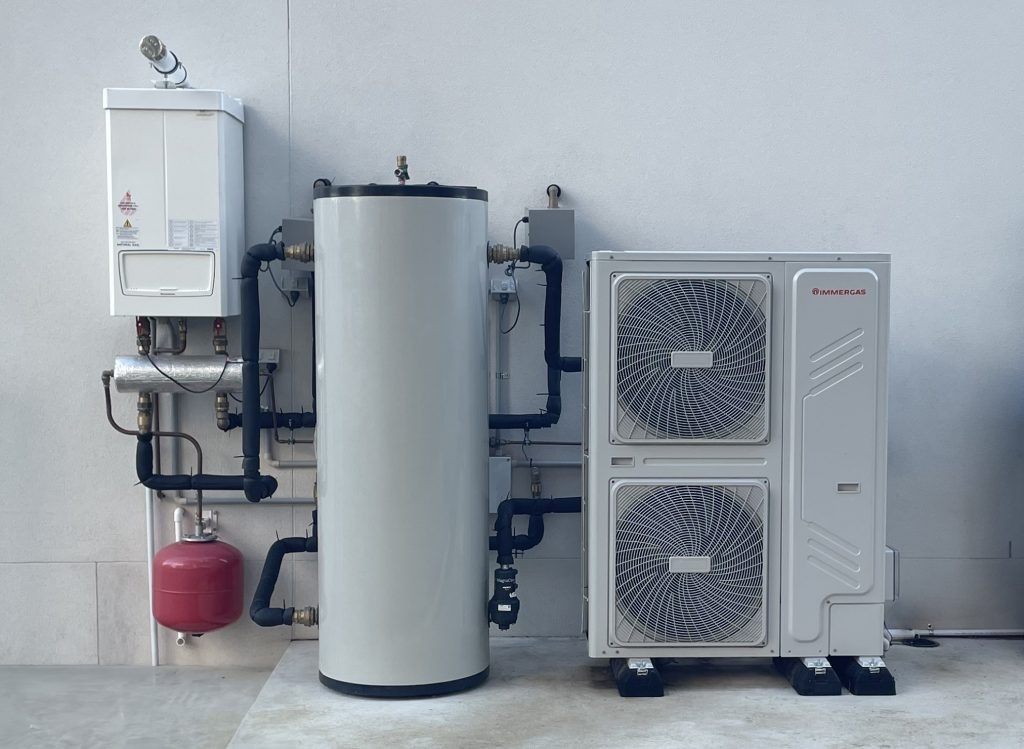
The majority of people who switch from a gas or oil boiler to a heat pump will keep running it the same way they ran their old system, and that habit is exactly what tanks efficiency once the temperature drops below zero. A heat pump rewards steady, low-temperature operation. It punishes the old “blast it on, shut it off” routine that worked fine with a combustion boiler. Getting through a hard winter without a shock power bill comes down to understanding a handful of thermodynamic realities and setting the system up to work with them, not against them.
Why “low and slow” beats on-demand blasting
Gas and oil boilers can be efficient at high output and so you can’t beat them for responding to sudden severe weather changes by rolling out maximum heat. One traditional tactic is to let the house cool down overnight, and then fire the boiler up to maximum temperature first thing in the morning in a bid for maximum recovery and minimum penalty. Heat pumps don’t work that way. Their COP is highest when producing steady (low) amounts of heat, not struggling to produce vast amounts of it all of a sudden.
When a heat pump has to claw back several degrees quickly, it needs a higher flow temperature to push out more heat, and the COP tumbles just when the prevailing outdoor conditions are strengthening the attack on the building and heat loss is really racking up. A typical air source heat pump might deliver a COP of 3.0 – 4.0 around 0°C, but only a pathetic 1.5-2.0 at -10°C and this deterioration right when you don’t want it is why some heat pump users pay more for their ‘cheap’ heat than they ever did for oil or gas.
Every degree of flow temperature you don’t need is money you’re not spending. Fix is easy in principle – don’t let the building get so cold in the first place, and instead of relying on the poor heat pump to claw back 3, 4, 5 degrees (getting worst COP all the time) in the morning, and every morning, just the one degree when the going really gets tough. A degree or two overnight is okay, but the enemy of good COP is a big setback.
Getting the weather compensation curve right
Weather compensation is the control feature that adjusts flow temperature automatically based on outdoor conditions, and it’s the single biggest lever you have for winter efficiency. The idea is to run the lowest flow temperature that still keeps rooms comfortable, adjusting that number as it gets colder outside.
Most installers set a default compensation curve at commissioning, but defaults are rarely tuned to your specific house. Too aggressive a curve and the system runs hotter than it needs to, dragging down COP. Too conservative and you’ll feel cold on the coldest days because the emitters can’t keep up. The right approach is to nudge the curve gradually over a few cold snaps: lower the flow temperature target slightly, watch how the house responds over 24-48 hours, and adjust again. You’re looking for the point where rooms hold their target temperature with the lowest possible flow water. This isn’t a one-off setting – it’s worth revisiting each season as your thermal envelope changes (new insulation, draught-proofing, glazing upgrades all shift the curve you need).
Setting the bivalent point in hybrid systems
If you have a hybrid setup with a gas- or diesel- boiler backing up the heat pump, the bivalent point is the outdoor temperature at which the backup boiler takes over because the heat pump alone can no longer meet the heating load cost effectively. Get this wrong and you’re either burning expensive fossil fuel when the heat pump could still handle things, or leaning on the heat pump at COPs so low it’s cheaper to switch to the boiler.
Properly calculating a bivalent point means comparing the running cost of the heat pump at a given COP to the cost of the backup fuel at that same heat demand, not just picking a round number like -5°C because it sounds reasonable. It also needs to take into account your heat pump’s actual output curve, which degrades differently model to model. This is one of those calculations that looks straightforward on paper but goes wrong constantly in the field, because it depends on accurate flow rates, correct sensor placement, and a control strategy that actually reads outdoor temperature rather than a rough timer schedule.
Homeowners can absolutely adjust basic thermostat and setback settings themselves, but calibrating flow rates, balancing low-loss headers, and integrating the auxiliary boiler correctly is a job for someone who commissions these systems for a living. Anyone running a hybrid setup through a genuinely cold winter should get a specialist to check this properly – firms offering Boiler Heat Pump Services Canberra deal with exactly this kind of hybrid calibration and can confirm the bivalent point is set to the actual physical characteristics of your system rather than a factory guess.
Why defrost cycles need a buffer tank
Ice forms on the outdoor evaporator coil whenever the air is humid and near freezing, which describes a huge chunk of winter weather. The heat pump has to periodically reverse its cycle and run a defrost, melting that ice off the coil so it can keep extracting heat from the air.
During a defrost cycle, the heat pump is briefly not producing useful heat for the house. It’s using energy to melt ice instead. Without a buffer tank, that dip shows up as a noticeable cold spell indoors, and the system’s controls may respond by pushing flow temperature harder once the defrost ends, which hurts COP. A properly sized buffer tank stores enough thermal energy to bridge these gaps, releasing heat to the house during the defrost without asking the compressor to work harder afterward. Undersized buffer tanks are one of the most common reasons people report their heat pump “struggling” in cold weather when the actual heat pump hardware is fine – the storage capacity around it just isn’t doing its job.
Flow rates and hydraulic balancing
To ensure safety and efficiency, a heat pump requires a minimum flow of water through its heat exchanger. If flow rate drops too low, the system can shut down due to a high-limit temperature fault – the water is heating up too fast relative to the volume of water passing the sensor. This is exacerbated in winter – when you’re already demanding the highest flow temperature and also have the most restricting valves – it’s a perfect storm.
Those valves are part of hydraulic balancing – ensuring water flows evenly and at the right volume through each and every circuit. It was always good practice but mattered little with a high-temperature boiler. With a heat pump, it matters more than ever. The low-loss header’s whole role in life is to separate the flow rate the heat pump wants to run at on the primary circuit from the flow rate the house wants to consume on the secondary distribution circuit. This lets both flow at optimal rates without one starving the other.
On simple one-to-one installations, the bypass valves serve the same function. They’re just a place to send the water if you’ve decided to close the zone valve off too much of the circuit. Skipping this step at install or leaving it set based on a summer load without checking it against real winter demand is probably the most common reason that the heat pump seems to perform brilliantly until it really matters, the cold hits.
The over-zoning trap
Heating systems with zoning and thermostatic radiator valves (TRVs) may seem like an efficient setup since you’re not wasting energy to heat rooms with the door closed. However, if too many zones/TRVs are closed it can limit the total water volume moving through the system, leading the flow rate to drop below the minimum operating threshold required by the compressor.
In this scenario, the heat pump goes into short-cycling mode: it switches on, immediately reaches a fault or limit, switches off, and then repeats the process. Short-cycling dramatically reduces the compressor’s lifespan and results in poor efficiency since the unit never operates long enough to reach its peak performance. The solution is not to give up on zoning strategies, but rather ensure that enough zones stay open, or a bypass path exists so that the minimum flow is guaranteed no matter how many zones/TRVs close. If you’ve closed off a few too many guest rooms and the system is cycling like mad, this is usually the culprit.
Protecting the outdoor unit itself
None of the control logic matters if the outdoor unit is physically compromised by snow and ice. A few things matter here. The unit needs to sit high enough off the ground to stay above the typical local snow line, since buried intake vents choke airflow and kill performance. Defrost cycles produce meltwater that has to drain away cleanly – if that water pools and refreezes underneath the unit, you get ice dams that block drainage entirely and can eventually damage the base pan. A simple gravel bed or raised platform with a slight fall solves most of this. Snow hoods over the top of the unit stop accumulating snow from packing into the fan and coil during heavy falls, which is a cheap fix for a problem that otherwise causes real airflow restriction.
Upgrading emitters for low flow temperatures
This is typically one people skip, because it costs money, but it’s often the difference between a heat pump that performs and one that quietly disappoints. Old radiators were sized based on the assumption you’d have boiler water at 70°C or more. Running a modern heat pump efficiently means flow temperatures comfortably closer to 35°C-45°C. Small, single-panel radiators simply can’t shed enough heat at that temperature to give you sufficient BTUs on a cold day.
The standard fix is doubling or tripling panel convector radiators, (often labelled Type 22 or 33) which have plenty more surface area and so can give enough emission at low flow temperatures. Underfloor hydronic heating really doesn’t have an issue here – it’s low-temperature, large-surface-area heat by design. If your gas-boiler small original radiators are what you were stuck with, then I’m afraid no amount of clever weather compensation tuning will make all of it up by matching undersized emitters with excess flow – you’ll end up needing a higher flow temperature than the heat pump would like, and consequently, COP suffers.
Getting a heat pump boiler system through severe cold isn’t about one big trick. It’s the sum of a dozen small calibrations – flow temperature, buffer capacity, flow rate, emitter size, physical protection – all pointed the same direction. Get them aligned and the system will quietly do its job through the worst weeks of winter. Leave any one of them mismatched and you’ll be reaching for the thermostat, wondering why the house never quite feels warm enough.